
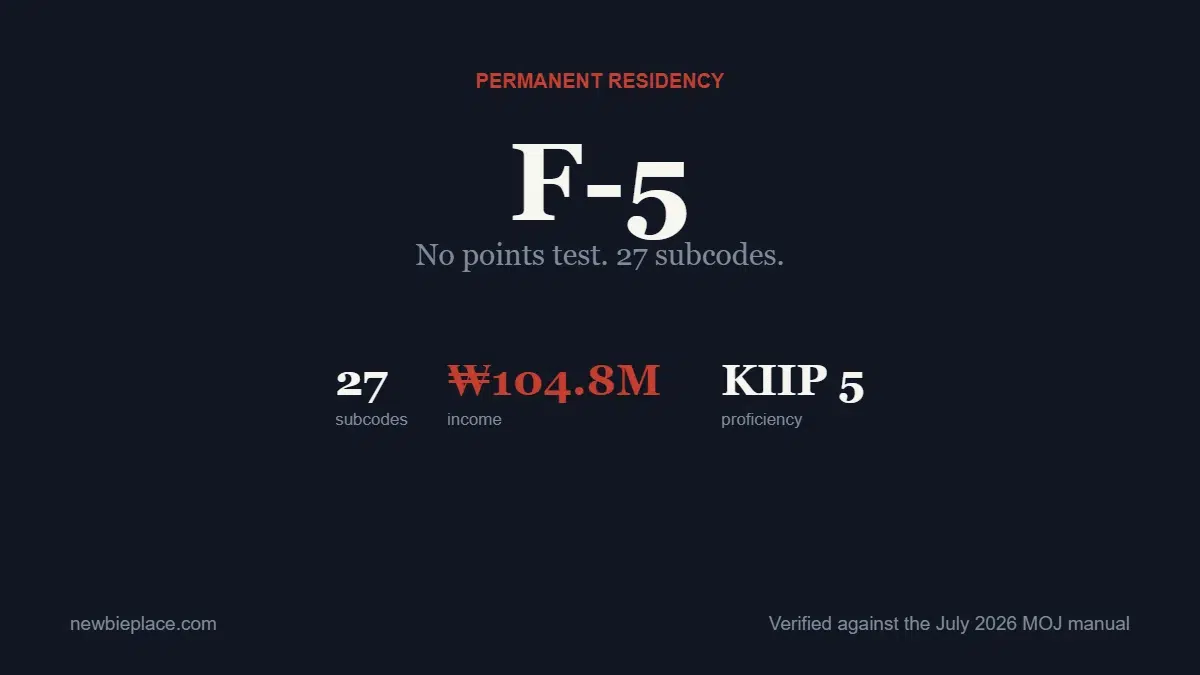

There is no points test for permanent residency in South Korea. That surprises people, because the visa one rung below it — the F-2-7 — is nothing but a points test.
F-5 works differently. It has 27 subcodes — F-5-1 through F-5-27 — each with its own eligibility rule. Some are independent routes; others are derivative codes for the spouse or minor children of someone who already holds F-5. All of them sit on top of the same three requirements: clean record, provable income, demonstrated Korean.
This guide covers what those three actually mean in numbers, and which subcode is likely yours.
Everything below comes from the Ministry of Justice’s Residence Application Manual by Status, July 2026 edition. Figures change annually. Confirm at HiKorea or call 1345 before you file.
The three requirements everyone meets
Whatever route you take, you clear these:
1. Good conduct (품행 단정) — no disqualifying criminal or immigration record.
2. Livelihood (생계유지) — income or assets above a threshold.
3. Basic proficiency (기본소양) — Korean language and social understanding.
Then your specific route adds its own condition — usually “hold visa X for Y years.”
Requirement 1: Good conduct
This is a list of disqualifiers, not a background check you pass or fail on vibes. You meet it if none of these apply to you.
Domestic record
| Situation | Blocked until |
|---|---|
| Imprisonment (금고 이상 실형) served or remitted | 5 years after completion |
| Suspended sentence, imprisonment-grade | 5 years after judgment final |
| Fine (벌금형) paid | 3 years after payment date |
| Deportation order (강제퇴거) | 7 years after departure |
| Departure order (출국명령) | 5 years after departure |
| 3+ Immigration Act violations in last 5 years | Blocked (administrative fines excluded) |
| ₩5M+ in Immigration Act penalties in last 3 years, or ₩7M+ combined | Blocked |
Certain violent crimes under the Act on Special Cases Concerning the Punishment of Specific Violent Crimes are a permanent bar, with no waiting period at all.
Overseas record
Here the manual is stricter than most people expect. A foreign conviction for specific violent crime, intimidation, extortion, fraud, three or more DUIs, voice phishing, or drug offences disqualifies you outright — the fact of the sentence is enough. Other foreign convictions at imprisonment-grade block you for 10 years from sentencing.
You will need a criminal record certificate from your country of nationality, plus one from any third country where you lived a year or more within the last five years.
Seven ways to skip the overseas certificate. The manual lists exemptions, and one is worth knowing: if you have lived in Korea legally and continuously for 10 years or more, you do not need it. Others include being under 14, applying for certain investor or doctorate routes, or not having spent six consecutive months abroad since you last submitted one.
The three-hour class. If you have any domestic law violation in the past 10 years, you must complete a civic compliance course (준법시민교육) — three hours — before your change of status is approved. You are exempt if you have already taken it with no new violations, or if you had one violation or fewer resulting in ₩1 million or less in fines.
Requirement 2: Livelihood — the numbers
Two ways to satisfy it. Income or assets. You cannot combine them.
For the two most common routes — general F-5-1 and points-based F-5-16 — the thresholds are:
| Route | Income needed | OR assets needed |
|---|---|---|
| Standard (F-5-1, F-5-16) | 2× per-capita GNI ≈ ₩104.8 million | 1.5× average household net worth ≈ ₩707 million |
| Marriage migrant (F-5-2) | 1× GNI ≈ ₩52.4 million | household net worth at or above the median |
Both figures come from annual statistics: per-capita GNI, published by the Bank of Korea (₩52,416,000 for 2025), and average household net worth from the national household finance survey (₩471.44 million as of March 2025).
Read the asset number again. ₩707 million in net worth — assets minus debt. For most applicants, income is the realistic path.
Four things that trip people up:
Family income counts, but you must carry half. You can combine income from a spouse, minor children, or parents who have lived with you and shared a household through the assessment period. But your own income or assets must be at least 50% of the threshold regardless. Exceptions exist if you are raising minor children or are a minor yourself. And for two routes — degree/certificate holders (F-5-10) and pension recipients (F-5-13) — only the applicant’s own income counts, full stop.
Only taxed income counts. The figure comes from your certificate of income amount (소득금액증명) at the tax office. Income you should have paid tax on but didn’t is not counted. Assets are not income — but rental income from an asset, taxed as business income, is.
The assessment period is a calendar year, not the last 365 days. If you apply on 1 January 2026 or 31 December 2026, either way they look at 1 Jan – 31 Dec 2025. If last year’s income certificate isn’t issued yet, they use the year before.
Assets must be held six months. Anything acquired within six months of your application doesn’t count, and the value must hold until approval. Deposits, funds, insurance, stocks, bonds, jeonse/wolse deposits count as financial assets; property counts at official assessed value.
One more filter: negative fiscal impact. Before they even compare your income to GNI, they check whether you owe anything. Unpaid national or local tax, customs duties, health insurance premiums, or administrative fines will fail you. So will income earned in a sector your visa doesn’t permit, or in gambling or adult entertainment. If a family member is the problem, they are simply excluded as an income source. If you are, your application fails on livelihood.
Requirement 3: Basic proficiency
Only two ways to satisfy this now:
- Complete KIIP Level 5 (사회통합프로그램 5단계), or
- Score 60+ out of 100 on the comprehensive evaluation for permanent residency or naturalization
TOPIK Level 4 used to work — but only for applications filed before 31 March 2019. If a guide tells you TOPIK gets you F-5, it is seven years out of date.
This is assessed for general residents (F-5-1), their spouses (F-5-4), points-based residents (F-5-16), their spouses (F-5-18), and degree/certificate holders (F-5-10).
Many investor and special-contribution routes are exempt entirely — high-value investors (F-5-5), specific-talent holders (F-5-11), special contributors (F-5-12), tourism/leisure investors (F-5-17), public-business investors (F-5-21/22/23), tech startup investors (F-5-24), conditional high-value investors (F-5-25), and children born to permanent residents (F-5-20).
If you are on a points track, you have probably already done this. KIIP Level 5 is worth 30 points toward F-2-7 — 20 for language plus a 10-point bonus. The same certificate then clears your F-5 proficiency requirement. It is the single most efficient thing you can do across both visas.
Which subcode is yours?
The full list runs F-5-1 through F-5-27. The ones most people use:
F-5-1 — General. You have held D-7 through E-7, or F-2, for 5 continuous years. You must still be economically active in that status. Extra conditions by visa: D-8 needs ₩1 billion average annual revenue over two years; D-9 needs ₩500 million in exports or ₩1 billion revenue; D-10 and E-7 need a bachelor’s degree or higher.
F-5-16 — Points-based. You have held F-2-7 for 3 continuous years. That’s the whole eligibility test. No new scoring — the points already happened at the F-2-7 stage.
Note what that means: the points-based route reaches permanent residency in 3 years, while the general route takes 5. If you qualify for F-2-7, it is not just a better visa — it is a shorter road.
F-5-2 — Marriage migrant. Married to a Korean national, held F-6-1 for 2 years, marriage genuine and ongoing. Lower income bar (1× GNI).
F-5-4 — Spouse/minor child of a general permanent resident.
F-5-18 — Spouse/minor child of a points-based permanent resident. Needs F-2-71 status and 2 years of the relationship continuing — and note, that means your spouse must have held F-5-16 for at least two years already. Income requirement drops to 1× GNI.
F-5-9 / F-5-15 — Doctorate holders, advanced fields and general fields respectively.
F-5-10 — Bachelor’s/master’s degree or certificate holders.
F-5-11 — Specific-talent holders.
F-5-13 — Pension recipients (only overseas pension income counts).
F-5-5, F-5-17, F-5-21/23, F-5-24, F-5-25 — Investor routes, each with its own capital threshold.
F-5-20 — Children born in Korea to permanent residents.
The path most readers are actually on
If you are working in Korea on a professional visa, there are two realistic routes, and the difference between them is two years:
The long way: stay on E-7 (or similar) for 5 years → apply F-5-1. Needs ₩104.8M income or ₩707M assets, KIIP 5, clean record.
The short way: qualify for F-2-7 on points → hold it 3 years → apply F-5-16. Same livelihood and proficiency bar at the end.
The second is faster, and it has a bonus: F-2-7 already frees you from employer sponsorship, so those three years are lived with far more freedom than three years on E-7.
There is a catch worth flagging. F-2-7 gives you a stay period of one to five years depending on your score and income — and if you get one year, you’ll renew twice before you’re F-5 eligible, re-scored each time, with your age points falling. The people who get five years walk to F-5 without a single renewal.
Which is why income does double duty. ₩60 million gets you a five-year F-2-7. ₩104.8 million clears the F-5 livelihood bar. The gap between those two numbers is the distance between “resident” and “permanent.”
Documents and filing
Standard set: application form, passport, ARC, photo, fee, proof of residence, plus route-specific evidence (degree certificate, employment contract, revenue records).
Livelihood evidence: certificate of income amount (소득금액증명), proof that taxes, health insurance and fines are paid, and — if going the asset route — property register extracts, contracts, balance certificates.
Conduct evidence: criminal record certificate from your country of nationality, plus any third country you lived in for a year or more within the past five years. Foreign documents need apostille or consular authentication with translation.
Proficiency: KIIP Level 5 completion certificate or evaluation score report.
The honest summary
F-5 is not a test you study for. It is a threshold you cross, and the three parts of it move at different speeds.
Your record is fixed — you can only wait out the clocks.
Your Korean is a project — KIIP Level 5 takes time but is entirely within your control, and it pays twice if you’re going through F-2-7.
Your income is the wall. ₩104.8 million is a genuinely high bar — about 1.4 times what the average Korean household earned in 2024 (₩74.3 million), and twice the per-capita figure the rule is actually pegged to. This is the requirement that decides most cases, and the one worth planning years ahead of.
Everything else is paperwork. For how F-5 fits among Korea’s other visas, see our complete guide to Korean visas.
Sources: Ministry of Justice / Korea Immigration Service, Residence Application Manual by Status (체류민원 자격별 안내 매뉴얼), July 2026 edition, permanent residence (F-5) chapter. Per-capita GNI: Bank of Korea provisional 2025 figure, ₩52,416,000, published 10 March 2026. Average household net worth: 2025 Household Finance and Welfare Survey, ₩471.44 million as of end-March 2025, published 4 December 2025. Last reviewed: July 2026.
This is a guide, not legal advice. The GNI and net-worth figures are revised annually, and the thresholds move with them. Confirm your own case with the Immigration Contact Center at 1345 or a licensed 행정사 before you file.