
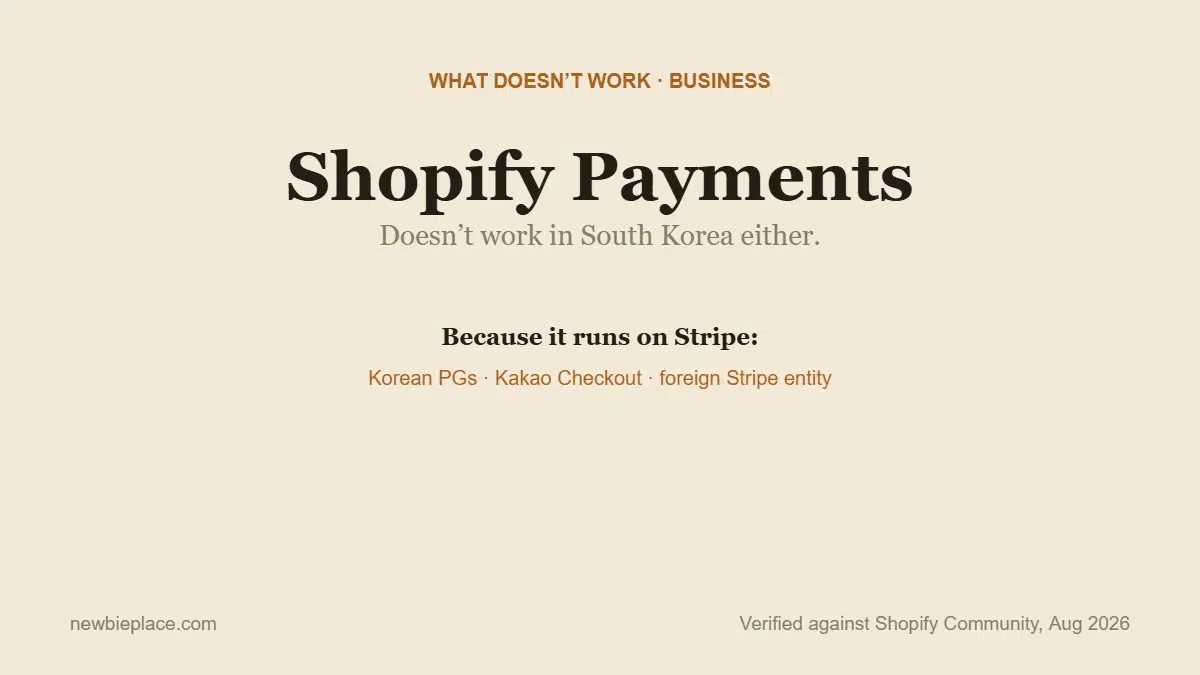

Shopify Payments does not work for a business registered in South Korea. This is not a separate problem from the Stripe issue covered in our earlier article. It is the same problem wearing a different name.
Shopify Payments is not its own payment processor. It runs on Stripe’s infrastructure. When a country is not on Stripe’s supported list, Shopify Payments cannot be activated for a business registered there either. As of 2026, that includes South Korea.
What Shopify’s own community says
Shopify’s own support staff have confirmed this directly, in response to a Korea-based merchant asking why payment setup was failing:
“Shopify Payments is not currently available in South Korea.”
As of 2026, Shopify Payments is active in roughly 38 to 39 countries and regions, including Japan, Singapore, and Hong Kong SAR. South Korea is not on that list. Eligibility is based on where the business is legally registered, not where its customers are — so a Korean company cannot activate Shopify Payments no matter how many countries its customers are in.
You can still run a Shopify store
This is worth separating clearly, because the two get confused constantly. Building a Shopify store is open to almost anyone, anywhere. Using Shopify Payments, the built-in processor with lower fees and no separate account, is restricted to merchants registered in supported countries.
A Korea-registered store can still sell to customers worldwide. It just cannot use Shopify’s own payment processor to do it. It needs a third-party gateway instead.
What Korean sellers actually use instead
Shopify integrates with over 100 third-party payment gateways worldwide, and a handful of them are built specifically for the Korean market:
KG Inicis — one of Korea’s most established gateways. Supports credit cards, bank transfer, and mobile payment methods commonly used by Korean shoppers, including KakaoPay, Payco, and Samsung Pay. Integrates directly with Shopify.
Eximbay — a Shopify-compatible gateway built around Korean and cross-border transactions, supporting major cards, bank transfers, and mobile payments.
KCP (Korea Cyber Payment) — provides card and mobile payment support, often used by larger merchants.
All three require the standard steps for a Korean payment gateway: business registration, identity verification, and integration setup through Shopify’s admin. None of them are instant — budget time for onboarding, the same as with any domestic PG.
Apps that don’t need a Korean business entity
Two official Shopify apps let a store accept Korean-preferred payment methods without registering a Korean entity at all:
Kakao Checkout — KakaoPay integration as a Shopify app, aimed at Korean shoppers who expect to check out with KakaoPay.
Samsung Pay (via CartDNA) — adds Samsung Pay as a checkout option with no separate coding required.
These do not replace a full payment gateway. They add specific Korean-preferred payment methods on top of whatever gateway is already processing the transaction.
The foreign Stripe account workaround
This is the same workaround covered in our Stripe article, and it applies here too. A Shopify store connected to a Stripe account registered in the EU, Hong Kong, UK, or US can accept payments from Korean customers using Korean cards and local payment methods — without a Korean business entity.
What it does not do: pay out to a Korean bank account as a Korean business. It works because the business is registered somewhere Stripe supports, not because Stripe made an exception for Korea. The same tax, foreign-exchange reporting, and cross-border structure questions from the Stripe article apply. This is not a default recommendation — it is one option among several, and it needs a Korean tax accountant’s input before anyone builds around it.
The cost of using a third-party gateway
Shopify charges an additional transaction fee, on top of whatever the gateway itself charges, when a store uses a third-party payment provider instead of Shopify Payments. That fee runs roughly 0.5% to 2%, depending on the store’s Shopify plan. Factor this into any fee comparison between the Korean PG options above — it is a Shopify-side cost, not a gateway-side one, and it applies regardless of which third-party gateway is chosen.
The Simple Decision Table
If Korean shoppers are the primary market, use a Korean PG — KG Inicis, Eximbay, or KCP — and accept the Shopify third-party gateway fee as a cost of doing business.
If Korean-preferred payment methods matter but a full Korean PG integration is too much for now, add Kakao Checkout or Samsung Pay on top of an existing gateway.
If the customer base is mostly outside Korea and Korean checkout methods are not essential, a foreign-registered Stripe account (with professional tax advice) may be simpler than standing up a Korean PG relationship.
If subscriptions or recurring billing are needed, confirm recurring-payment support with each Korean PG directly — this varies and is not always advertised clearly.
Bottom Line
Shopify Payments does not work in South Korea because it runs on Stripe, and Stripe does not support Korea as of 2026. That single fact explains the entire situation. A Korean-registered Shopify store is not blocked from selling — it just needs a Korean PG, a Korean-specific app layered onto an existing gateway, or a foreign entity structure, evaluated with the same care as any other cross-border payment decision.
Sources: Shopify Community official support responses on Korea payment gateway setup; Shopify Payments supported-countries documentation, 2026; Stripe global availability page, checked 2026-08-10. Last reviewed: August 2026.
This is a guide, not legal or tax advice. Gateway availability and fees change; confirm current terms directly with Shopify and any payment provider before building a store around them.