
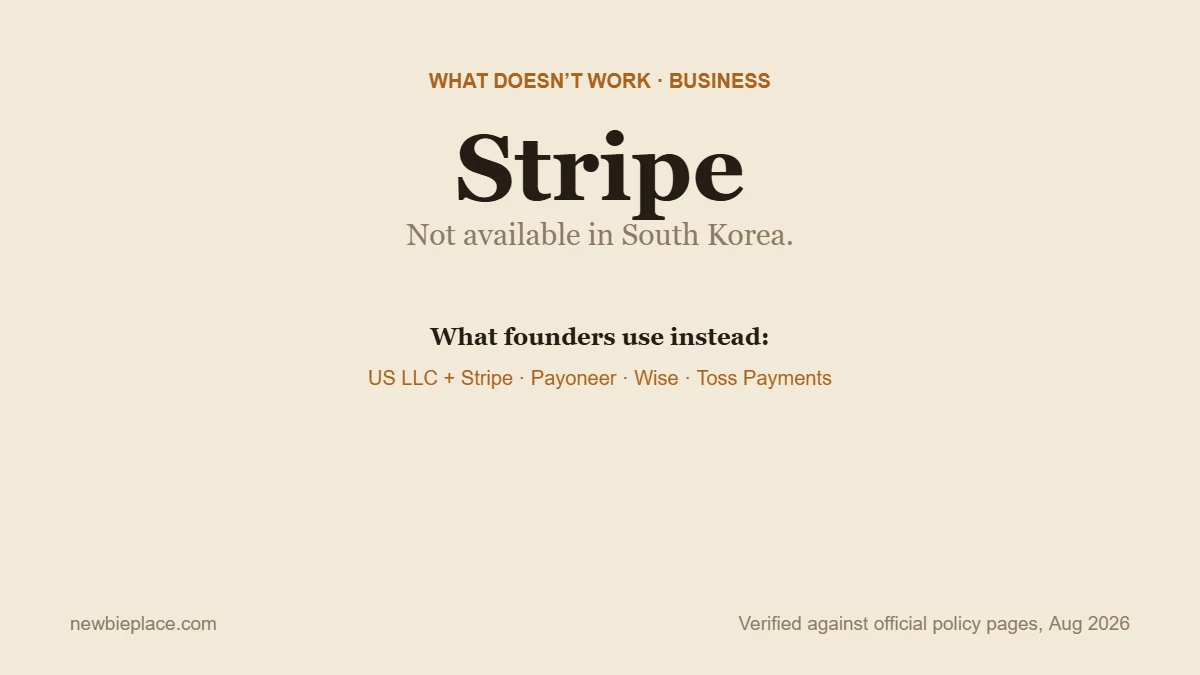

Stripe is not generally available for a company incorporated in South Korea.
That is the practical answer.
If your company is a Korean entity, with a Korean business registration and Korean settlement needs, do not plan around a normal Stripe account for that entity. Stripe’s own global availability page lists supported countries and regions. South Korea was not on that list when checked on 2026-08-10.
This does not mean Korean customers cannot pay online. They can. It does not mean Korean founders cannot sell internationally. They do. It means Stripe is not the local merchant-account and payout path for a Korea-based business in the way it is for a business in the United States, Singapore, Japan, Australia, or many European countries.
Payments are not only an API. They are acquiring, settlement, refunds, fraud handling, tax records, card-network rules, local identity checks, and consumer protection. In Korea, those pieces usually run through a domestic payment gateway, usually called a PG.
Why Stripe Is Not The Local Option
Stripe availability is based on where the business is established. Stripe says businesses in supported countries and regions can use Stripe to accept payments from customers around the world. The customer location is not the only question. The merchant country matters.
As of 2026-08-10, South Korea was not listed as a supported Stripe country.
So the local problem is narrow. A Korean merchant cannot simply create a standard Stripe account for a Korean company and settle to a Korean business bank account. A founder searching this keyword is usually trying to ship checkout, subscriptions, invoices, or global cards. The need is real. The Stripe path is not.
The replacement depends on the customer and the transaction.
If the customer is in Korea, use a Korean PG. If the customer is an overseas client paying invoices, compare Wise and Payoneer. If the product is global SaaS or digital goods, compare a merchant of record with a foreign entity structure. If the only reason to form a U.S. company is “Stripe,” pause. That may work operationally for some founders. It is not automatically safe under Korean tax, foreign-exchange, corporate, or reporting rules.
Toss Payments
Toss Payments is one of the more approachable domestic PG options for founders.
Its developer documentation includes English materials for international merchants. It explains Korean payment concepts and provides integration docs for payment windows and widgets. The documentation lists payment methods such as cards, account transfer, virtual account, mobile phone payment, gift certificates, and wallets including Toss Pay, Naver Pay, Samsung Pay, and Kakao Pay. It also includes international-card related parameters.
There are Korean-specific details. Toss documentation notes that normal testing may require a Korean payment method, such as a Korean card or bank account. It also notes card installment behavior for payments over ₩50,000 (about $34).
Toss fits best when:
- You have, or will have, a Korean business entity.
- Your buyers are in Korea.
- You need Korean checkout methods, not only foreign cards.
- You can complete Korean onboarding and contract review.
- You want comparatively modern developer documentation.
Do not assume every Toss feature is available to every merchant. Fees, settlement cycles, restricted industries, recurring billing, refunds, international cards, and payment methods can depend on contract terms.
NHN KCP
NHN KCP is a large Korean payment company. Its English site describes ecommerce payment, authentication, and store management services. Its developer guide shows a more traditional PG structure: customer, merchant server, payment window, KCP servers, gateway, card issuer, and approval.
This may feel heavier than Stripe. That does not make it unusual. It reflects how Korean card and payment rails are commonly wired.
KCP is worth evaluating when:
- You are building for Korean consumers.
- You need a mature domestic PG.
- Your commerce stack or agency already supports KCP.
- You can handle Korean-language support and paperwork.
Before development, ask about your exact business category. Ask about billing keys, recurring payments, failed payments, partial cancellations, refunds, international cards, Apple Pay, Naver Pay, Kakao Pay, and settlement timing. Do not infer Stripe-like behavior from the word “card.”
KG Inicis
KG Inicis is another major Korean PG. Its official site describes online electronic payment services, including credit cards and other payment methods. Its company profile describes PG, VAN, rental payment, global payment, and authentication services. It also states 2024 transaction volume of ₩33 trillion (about $22.8 billion).
KG Inicis appears often in Korean ecommerce stacks. Wix also lists KG Inicis as a South Korea payment provider, with KRW support and methods including cards, Apple Pay, Naver Pay, Samsung Pay, Kakao Pay, SSG Pay, LPay, and Payco. That Wix page is not the KG Inicis contract. It is only useful platform context.
Inicis fits best when:
- Your store is Korea-first.
- Your website builder or ecommerce stack already supports it.
- You need established domestic payment coverage.
- You are prepared for Korean onboarding.
Again, verify directly. Payment-method lists on marketing pages are not a merchant agreement.
Payoneer
Payoneer is not a Korean checkout replacement for Stripe.
It is better understood as an international receiving and payout tool. Payoneer materials describe receiving payments from international clients through receiving accounts, payment requests, and platform payouts. Payoneer Korea materials say Korean users can receive in currencies such as USD, EUR, GBP, JPY, AUD, and CAD, and withdraw to Korean bank accounts.
This can help:
- Freelancers billing foreign clients.
- Agencies receiving overseas payments.
- Sellers receiving marketplace payouts.
- Founders collecting foreign-currency revenue before KRW withdrawal.
It does not give Korean consumers a familiar domestic checkout. It does not replace Korean card authentication. It does not remove accounting work. Fees and FX spreads can matter.
Use Payoneer when the payment is closer to B2B receivables or marketplace payout. Do not use it as a one-for-one Stripe Checkout substitute.
Wise
Wise can also help with international transfers and currency operations. Wise’s availability pages show services for South Korea, including sending money and receiving money in other currencies through account details. Wise Business eligibility depends on country, business type, and account details.
Wise is useful when you need:
- International invoices.
- Foreign currency account details.
- Cross-border vendor payments.
- FX visibility.
Wise is not a domestic Korean PG. It is a finance operations tool. That is a different job.
Foreign Company Workarounds
Many Korea-based founders ask about forming a U.S. LLC, opening a U.S. bank account, and using Stripe through that company.
This is a known operational route. Stripe also promotes Stripe Atlas for company formation. But a product that can form a U.S. company does not settle the Korean founder’s tax and legal position.
A Korea-resident founder may still have Korean tax obligations. A Korea-managed business may still have Korean reporting issues. Foreign revenue may raise foreign-exchange reporting questions. A U.S. company may create U.S. filings, sales-tax analysis, transfer-pricing issues, and banking compliance questions.
This article does not recommend a foreign entity as a safe default workaround.
It may be appropriate for some founders. It may be inappropriate for others. Speak with a Korean tax accountant and a lawyer familiar with cross-border startup structures before relying on it.
The Simple Decision Table
If you sell to Korean consumers, start with Toss Payments, NHN KCP, or KG Inicis.
If you sell to Korean businesses, use a Korean PG when card checkout is needed. If invoices and bank transfers are acceptable, Korean bank transfer may be simpler.
If you sell services to overseas clients, compare Wise and Payoneer.
If you sell global SaaS, compare a merchant of record, a Korean PG for Korea, and a foreign entity structure. Model tax and fees before choosing.
If you need subscriptions in Korea, ask each PG specifically about billing keys, recurring card billing, failed-payment handling, customer authentication, cancellation rules, and issuer behavior.
If you need Apple Pay, Naver Pay, Kakao Pay, Samsung Pay, Payco, or international cards, ask which methods will actually be enabled for your merchant ID.
Bottom Line
Stripe does not work in South Korea in the normal local-merchant sense because South Korea was not on Stripe’s supported country list as of 2026-08-10.
For Korean checkout, evaluate Korean PGs. For international receivables, evaluate Wise or Payoneer. For global SaaS, evaluate merchant-of-record services or foreign structures with professional advice.
The correct payment setup is boring. It matches the legal entity. It matches the customer. It settles into the right bank account. It produces usable tax records. It supports refunds. It does not rely on an unreviewed workaround.
Start there.