
 and the D-8-4 tech startup route, with free OASIS support and the 2026 pathway.)
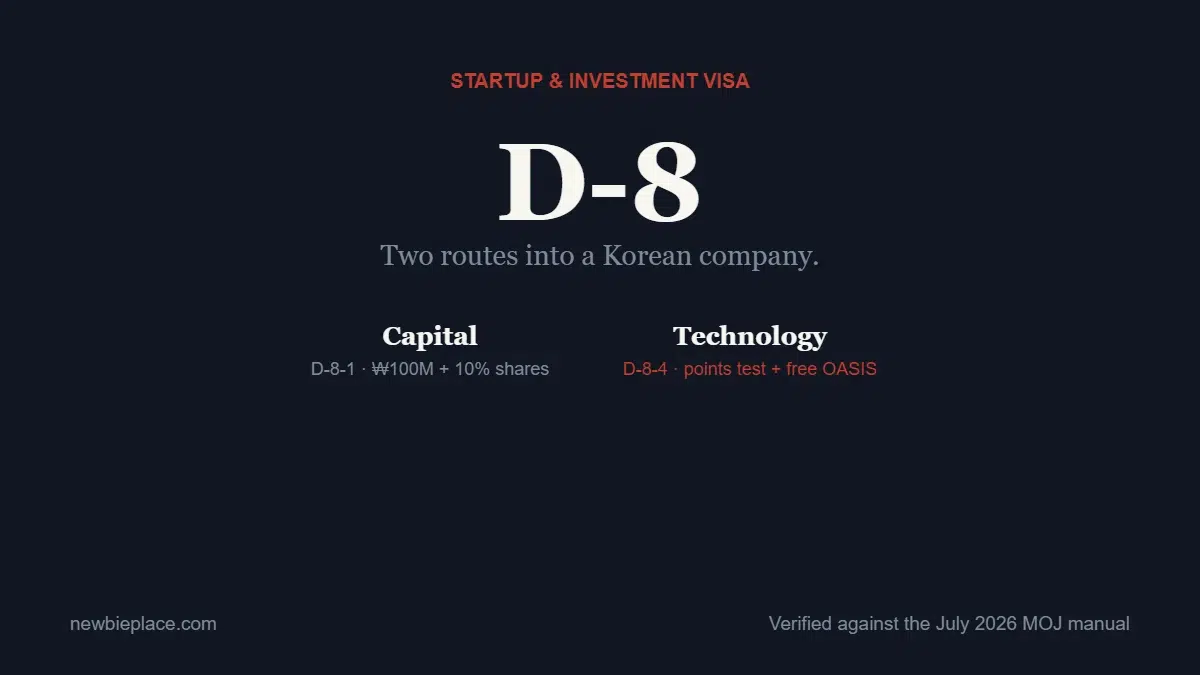
There are two ways to start a business in South Korea as a foreigner, and they lead to two different visas. One is for people bringing capital. The other is for people bringing an idea. The government cares about them very differently, and most guides blur the two into a single “startup visa” that doesn’t exist.
This guide separates them. If you have money to invest, you want D-8-1. If you have technology and want the government to help you build it, you want D-8-4 — and a set of free programs most founders never hear about.
Everything about the visa requirements below is drawn from the Ministry of Justice’s Residence Application Manual by Status, July 2026 edition. The support programs change yearly; confirm current details before you rely on them.
The D-8 family: four codes, two philosophies
D-8 is not one visa. It is four, and they split cleanly into capital and technology.
| Code | Name | For | Max stay |
|---|---|---|---|
| D-8-1 | Corporate investment | Investing in a Korean corporation | 5 years |
| D-8-2 | Venture investment | Founders of certified venture firms | 2 years |
| D-8-3 | Individual enterprise investment | Investing in a Korean-run business | 5 years |
| D-8-4 | Technology startup | Tech founders scored on points | 2 years |
Notice the stay lengths. The capital routes (D-8-1, D-8-3) grant five years. The technology and venture routes grant two. That difference tells you how Korea thinks: money is treated as stable, an idea as something still being proven.
We’ll take the two most common — D-8-1 for capital, D-8-4 for technology — in turn.
The capital route: D-8-1
If you are putting your own money into a Korean company, this is your visa. The requirement is precise, and it has two parts that must both be true.
₩100 million invested, and at least 10% of voting shares. Under the Enforcement Decree of the Foreign Investment Promotion Act, you must invest at least one hundred million won in a completed Korean corporation and hold 10% or more of its voting stock. Meeting only one of the two is not enough. (There is an alternative: hold shares and also secure an executive dispatch or appointment contract, but the ₩100M floor stays.)
The investment must be in a corporation that already exists — a completed legal entity, in the manual’s words. And the money must be yours: investment funds are expected to be in the applicant’s own name. Your spouse’s or minor child’s funds can be accepted by exception, but that is the exception, not the rule.
The ₩300 million line. This is the number that quietly governs everything, and almost no English guide mentions it.
– Below ₩300 million, you are treated as a small investor. You must submit extra documentation proving how the capital was actually used — purchase receipts, office fit-out costs, bank transaction records. And immigration will generally steer you to apply from abroad through visa issuance, rather than changing status inside Korea. – At or above ₩300 million, or with a substantial investment track record, immigration can approve an in-country status change after close review. You also gain a practical benefit: at this level, funds remitted in your parents’ or parents-in-law’s names can be counted.
So while the legal floor is ₩100 million, the number that makes your life easy is ₩300 million. Below it, expect friction and a likely trip home to get your visa.
D-8-3, the sibling. If you invest in a business run by a Korean individual rather than a corporation, that’s D-8-3: same ₩100 million and 10% thresholds, but you must be registered as co-representative alongside the Korean owner, whose own business capital must also be at least ₩100 million. It also carries the five-year stay.
D-8-1 asks one question: is your money real and committed? If yes, it gives you five years and largely leaves you alone. There are no government grants waiting for you — capital investors are expected to fund themselves. Which is exactly where the other route differs.
The technology route: D-8-4
D-8-4 is for founders whose asset is an idea, not a bank balance. Instead of a capital threshold, it uses a points test — and this is where the government’s money enters the picture.
300 points possible. You need 60, plus at least one required item. The scoring splits into required and optional items, and both allow you to stack multiple entries.
Some of the heaviest required items:
| Required item | Points |
|---|---|
| Registered patent | 60 |
| Registered utility model / design | 30 |
| ₩100M+ in investment raised (AC/VC, verified by the Global Startup Immigration Center) | 60 |
| Government startup grant, or OASIS-6 / OASIS-9 completion | 30 |
| Held professor (E-1) or researcher (E-3) status for 3+ years | 30 |
And optional items that top you up:
| Optional item | Points |
|---|---|
| Master’s degree or higher | 20 |
| TOPIK Level 5+ or KIIP Level 5+ | 10 |
| TOPIK Level 3+ or KIIP Level 3+ | 10 |
| Various OASIS courses (1, 2, 4…) | 10–15 each |
Look at what appears on both lists: OASIS. It isn’t a side benefit — it is baked directly into the visa score. Which means the fastest way to understand D-8-4 is to understand OASIS.
OASIS: the government program behind the visa
OASIS — the Overall Assistance for Startup Immigration System — is a joint program of the Ministry of Justice and the Ministry of SMEs and Startups. It is built for exactly one purpose: to take a foreign founder with an idea and walk them to a startup visa.
It provides classes, mentoring, incubation, and startup support, and the courses are free — though attendance in Korea is required. The courses are numbered (OASIS-1 through OASIS-9), each covering a different stage: intellectual property basics, startup fundamentals, mentoring, exhibitions, commercialization. Completing them earns the very points the D-8-4 test asks for. OASIS-6 or OASIS-9 completion is worth 30 points on the required list on its own.
The programs are administered through the Global Startup Immigration Center and partner institutions — the Seoul Business Agency, KISED (the national startup institute under the SME ministry), and others. The K-Startup portal (www.k-startup.go.kr) is the entry point.
There are also two fast lanes worth knowing:
– K-Startup Grand Challenge participants who establish a corporation and receive a Ministry recommendation can have the points test waived entirely. – The Startup Korea Special Visa works similarly: pass review by a private evaluation committee, get a Ministry of SMEs and Startups recommendation, and use it toward a status change.
In 2026, Korea is putting serious money behind this — the SME ministry’s startup budget runs to trillions of won, and the Grand Challenge alone selects roughly a hundred teams a year with cash prizes for the top finishers. The country is, quite openly, trying to buy itself a foreign founder base.
The three-step path most founders actually take
Here is how the technology route works in practice in 2026. It is not one application but a sequence, and it exists because immigration wants a reviewable paper trail.
Step 1 — OASIS certificate. Complete at least one OASIS course. This produces a certificate that immigration recognizes as evidence you’re a serious founder. It does not grant a visa by itself — in 2026, officers treat it as a positive but not sufficient condition.
Step 2 — D-10-2, the startup preparation visa. This is the runway. Open only to OASIS participants, it gives you six months, extendable up to two years, to actually build: secure an address, open a corporate account, incorporate, develop your product. You need at least one completed OASIS course to qualify. This is the working period where a concept becomes a company.
Step 3 — D-8-4, the startup visa. Once you’ve incorporated a technology business and cleared 60 points, you convert to D-8-4 proper. Initial validity is one year, renewable as long as the business keeps operating.
Think of it as: OASIS proves you’re qualified, D-10-2 gives you time to build, and D-8-4 is the residence status you land on. It is slower than D-8-1 — but then, you’re not being asked for ₩100 million up front.
Which route is yours?
The honest test is simple.
You have capital. If you can invest ₩100 million and take 10% of a company — and ideally ₩300 million to avoid friction — D-8-1 is the direct path. Five years, no points, no coursework, no government programs. You fund yourself, and the visa mostly stays out of your way.
You have technology. If your asset is intellectual property, a product, or an idea a Korean ministry might back, D-8-4 is built for you — and OASIS exists to carry you there. It takes longer and asks you to earn points, but the government is actively spending money to help you clear them.
Most people know which they are before they finish reading this sentence.
A note for people weighing this against simply living in Korea while working remotely: a startup visa is a serious, multi-year commitment to building a company here. If your goal is to reside in Korea while running a business based elsewhere, look first at the digital nomad visa (F-1-D), which asks for far less.
After the startup: where D-8 leads
D-8 is not a dead end. Held long enough with a real operating business, it becomes a path to permanent residency. The general PR route (F-5-1) accepts D-8 holders after five continuous years — with the added condition, for D-8, of roughly ₩1 billion in average annual revenue over two years. That’s a high bar, but it means a successful company can carry its founder all the way to permanent status. We cover that in detail in our guide to F-5 permanent residency.
For how D-8 fits among South Korea’s other visas, see our complete guide to Korean visas.
The honest summary
“Startup visa” is a phrase that hides a fork in the road. One branch is for capital: D-8-1, ₩100 million and 10% of a company, five years, fund yourself. The other is for technology: D-8-4, a points test the government will actively help you pass through free OASIS programs, reached over a three-step path that gives you time to build.
The paperwork differs, the timeline differs, and the amount of government help differs enormously. But they start from the same question — capital or idea? — and everything else follows from your answer.
Sources: Ministry of Justice / Korea Immigration Service, Residence Application Manual by Status (체류민원 자격별 안내 매뉴얼), July 2026 edition, corporate investment (D-8) chapter; Enforcement Decree of the Foreign Investment Promotion Act, Article 2. Startup program details: Global Startup Immigration Center, Startup Korea, and the K-Startup portal (www.k-startup.go.kr), 2026. Last reviewed: July 2026.
This is a guide, not legal advice. Investment thresholds and program requirements change; confirm your own case with the Immigration Contact Center at 1345, the Global Startup Immigration Center, or a licensed 행정사 before you file.